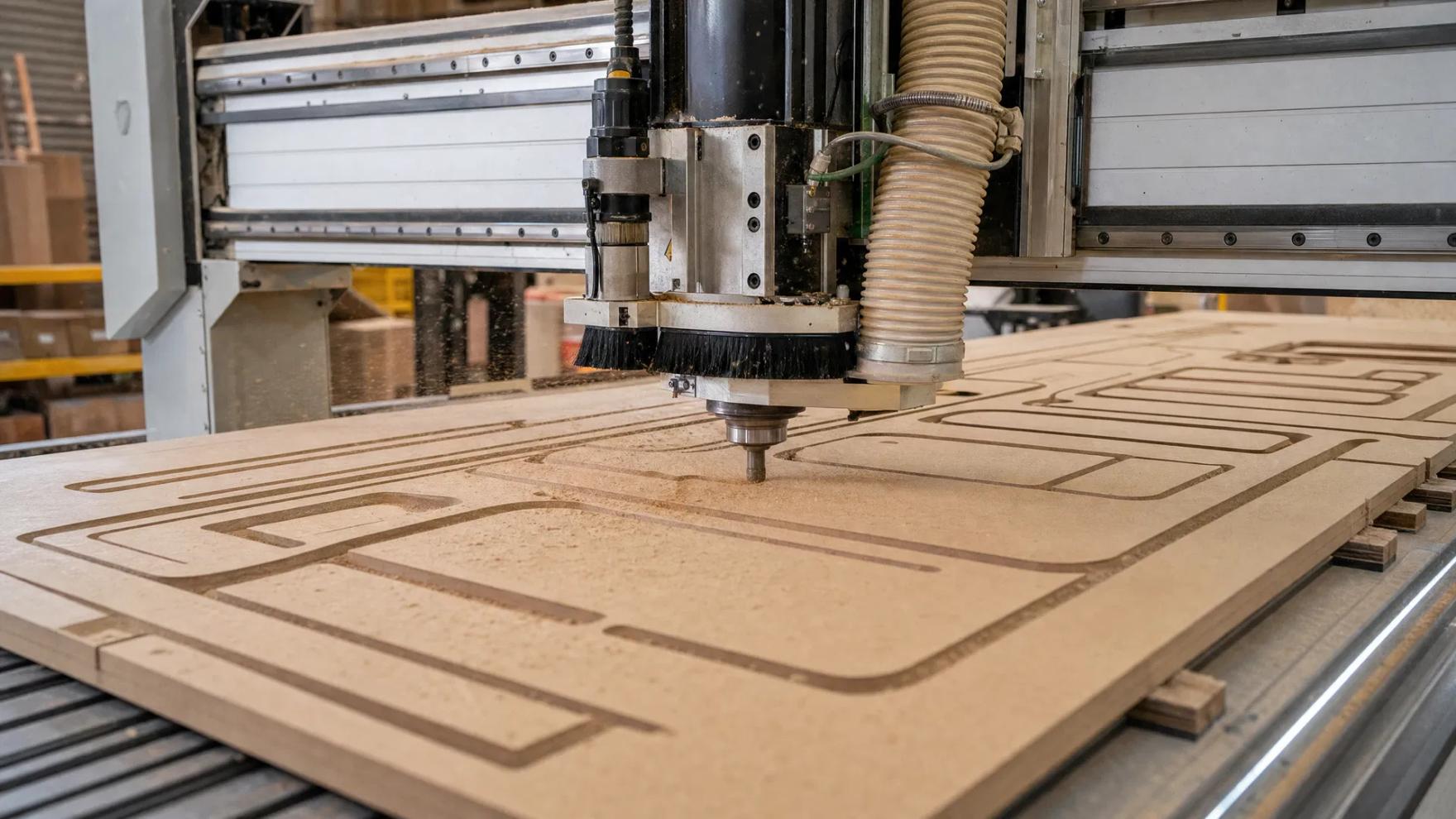
"CNC-ready" is the most over-promised phrase in millwork drafting. A PDF that prints clean is not the same as a file set your machine can run without a programmer rebuilding it. Here is the difference.
- CNC-ready means
- Files post clean to your specific controller
- Not enough
- A pretty PDF and a generic export
- What it needs
- Verified nesting, tooling, bore, and edgebanding
Submittal-ready vs CNC-ready
A submittal-ready set answers the architect: dimensions, finishes, joinery, schedules. A CNC-ready set answers the machine: part geometry, tooling, bore patterns, nesting layout, and edgebanding — posted for the controller on your floor. The two overlap, but a set built only for submittal will stall production the moment it reaches the saw.
The file set that actually runs
A genuinely CNC-ready delivery includes the native project file, a cut list, a nesting report with yield, a hardware schedule, an edgebanding report by part, an assembly sequence, and labels — plus the posted machine code itself. Each part should carry its grain direction, edge treatment, and bore so the floor is not interpreting the drawing on the fly.
Why the machine matters
There is no universal CNC file. Code posted for a Biesse Rover is not code for an SCM Morbidelli or a Holzma saw. Tooling libraries, bore offsets, and post-processors differ. "CNC-ready" without naming your machine is marketing. We post for your specific controller — tell us the make and model and we configure for it.
Where generic exports fail
A generic export wastes material with un-optimized nesting, misses bores that a part needs, or assumes tooling your machine does not have. The errors do not show on the PDF — they show when the floor sits idle and the late job gets later. This is exactly the failure a real CNC-ready process is built to prevent.
How we verify before delivery
Before a set ships, we verify nesting yield and grain direction, confirm tool paths against your machine, and reconcile the bore and edgebanding reports with the drawn parts. Every set is senior-reviewed so the file that lands on your floor is the file that runs.