What AWI compliance actually means for your drawings.
"AWI-compliant" gets used loosely. Here is what the standard genuinely requires of a shop-drawing set, what each grade demands, and how we meet it on every deliverable.
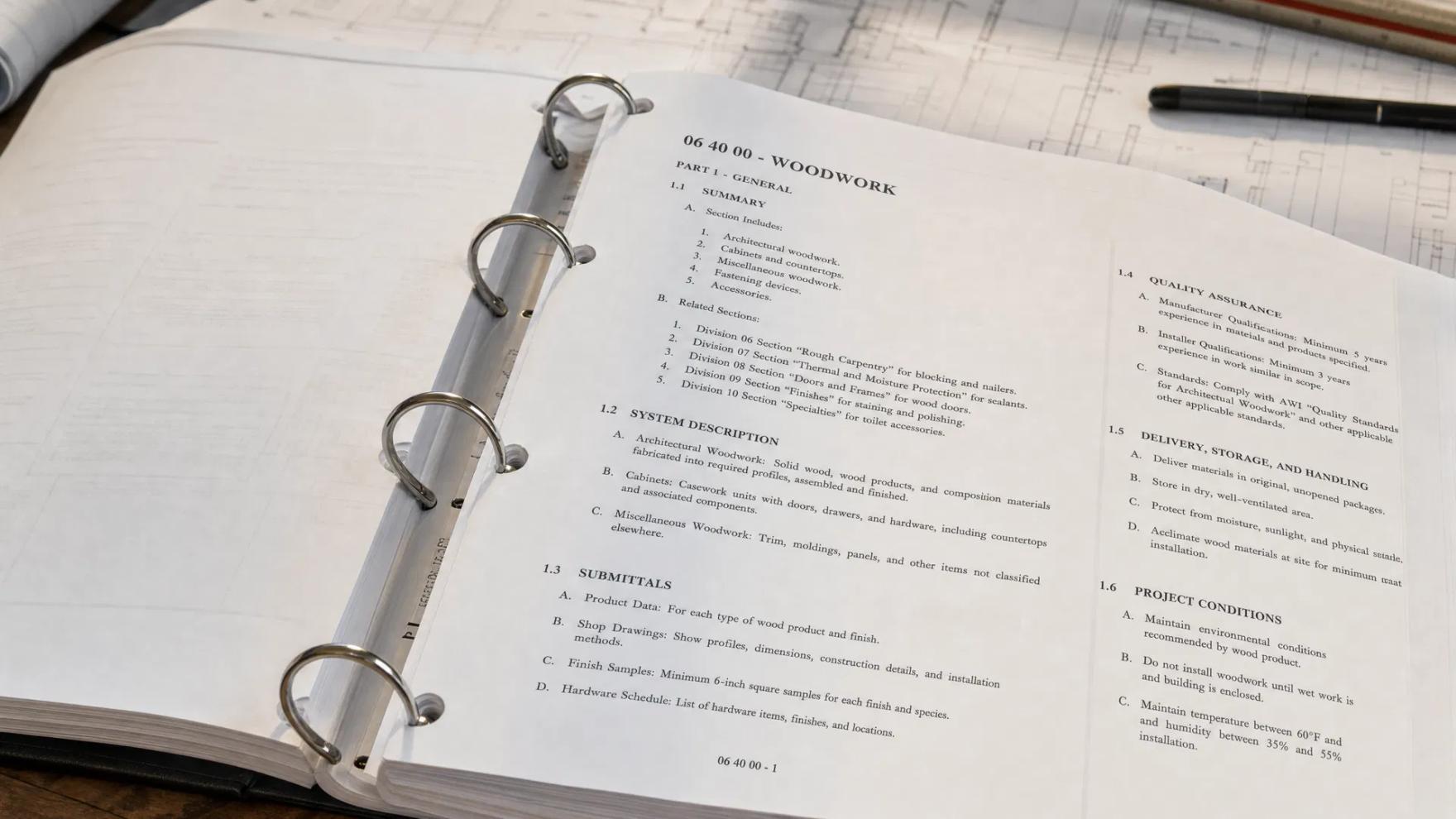
The standard behind the phrase
The Architectural Woodwork Institute (AWI) publishes the standards that define quality, tolerance, and construction for architectural millwork in North America — most projects reference the AWI Architectural Woodwork Standards (AWS). When an architect specifies a millwork grade and a GC submits a package for review, those standards are the yardstick the package is measured against.
The Quality Certification Program (QCP) is the auditing layer on top of the standards. On QCP-registered projects, the drawings, the shop, and the installed work are all expected to demonstrate conformance to the specified grade. That makes the shop-drawing set the first place compliance is proven — or where it falls apart.
Economy, Custom, Premium
The specified grade changes what your drawings must show — joinery, gaps, flushness, and veneer matching all tighten as the grade rises.
| Economy | Custom | Premium | |
|---|---|---|---|
| Typical use | Back-of-house, utility, budget-driven work | The default for most commercial projects | High-visibility, showpiece, and luxury work |
| Joinery & construction | Functional; fewer construction callouts required | Defined joinery and assembly shown by detail | Tightest construction tolerances, fully detailed |
| Flushness & gaps | Looser allowances | Controlled gaps and alignment | Minimal, uniform reveals throughout |
| Veneer matching | Not typically required | Matched within panels; sequence as specified | Sequence-matched and balance-matched sets |
| What the drawings must prove | Dimensions, materials, basic hardware | Grade callouts, joinery, hardware schedule, finish | All of Custom, plus matching sequence and reveal control by sheet |
Summarized for orientation. The governing requirements are the published AWI standards and the project specification — always defer to the specified edition and section for your project.
How a set proves compliance
Compliance is not a stamp — it is what the drawings actually show. Every Millmetric set carries the callouts a reviewer looks for.
Grade & specification callouts
The specified AWI grade and governing spec section called out on the cover and carried through, so the reviewer can measure the set against the right yardstick.
Joinery & construction details
Casework construction, edge treatment, and joinery shown by section and detail — not left implied — to the level the grade requires.
Veneer & finish matching
Veneer match type, sequence, and finish schedule documented by sheet, with reveal alignment called out for Custom and Premium work.
Hardware schedule
Hinges, pulls, slides, and locks quantified and specified by part number, so submittal review and procurement work from the same list.
Dimensions & tolerances
Plans, elevations, and sections fully dimensioned, with tolerances appropriate to the grade and verified against field conditions.
Senior review before it ships
Every set is marked up and reconciled by a senior reviewer on the Millmetric team before delivery — the step that keeps packages from coming back.
We draw to the grade your project specifies and call it out explicitly — no guessing, no "should be fine." If a spec is ambiguous, we raise it as an RFI before drafting rather than after submittal. The goal is simple: a package your GC and architect accept without a revision cycle.
Important: Millmetric produces shop drawings for fabrication. Final responsibility for code compliance, structural integrity, and regulatory approval rests with the licensed architect, engineer, GC, and manufacturer of record on your project.
Related reading
Need a set that clears review the first time?
Send us your drawings and the specified grade — we'll scope an AWI-compliant set and return a fixed estimate in 24–48 hours.