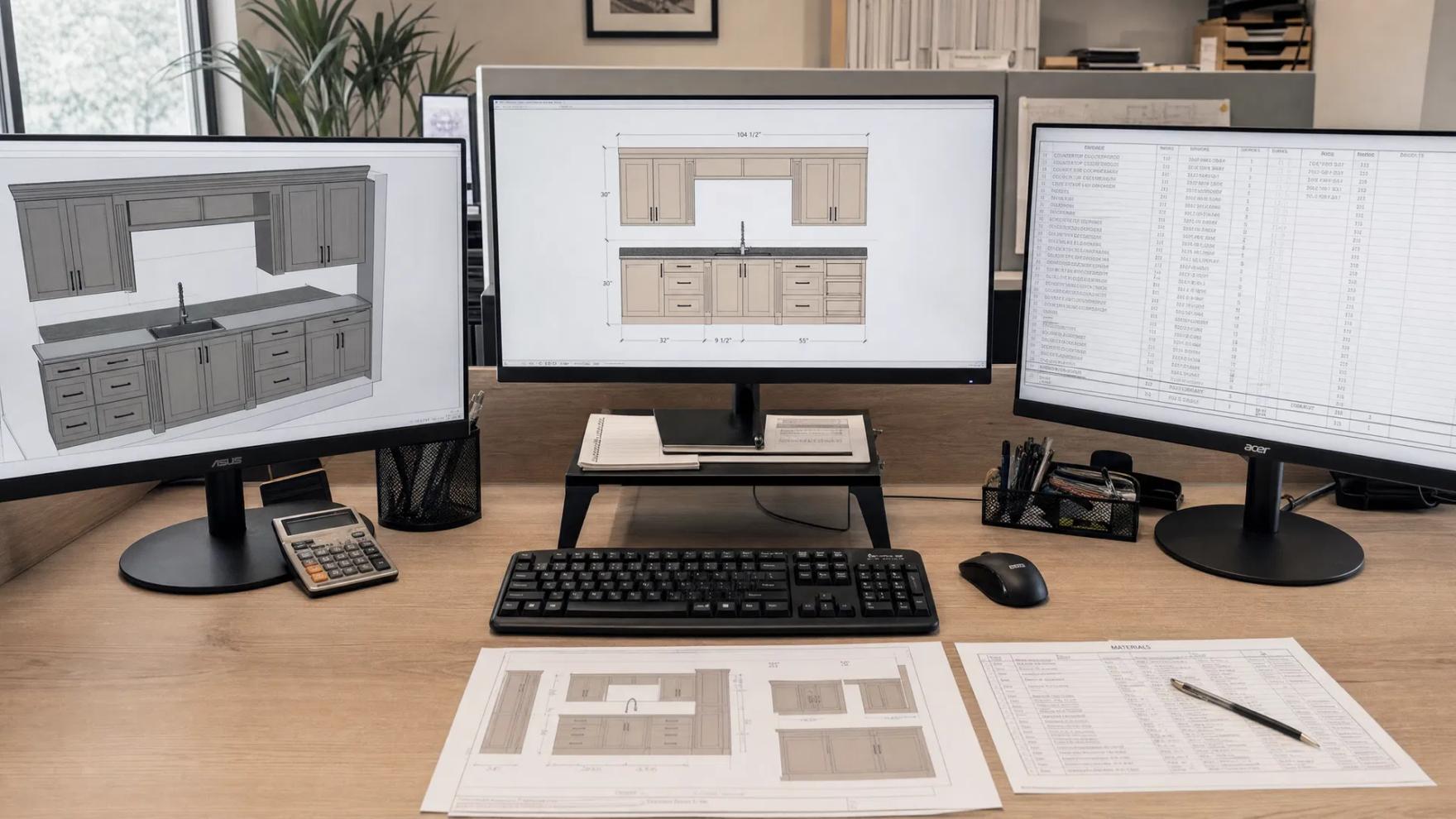
Most millwork drafting runs on one of three platforms. They are not interchangeable, and the right choice depends less on the software than on how your shop builds and what your machine expects. Here is the honest comparison.
- Parametric & CNC
- Microvellum, Cabinet Vision
- Drawing-first
- AutoCAD / BricsCAD
- The real question
- How does your shop actually build?
Microvellum
Microvellum is a parametric system built on AutoCAD: products are driven by a library of starters, processing rules, and hardware tokens. Set up correctly, it produces coordinated drawings and CNC output from one model, and changes propagate instead of being re-drawn. Its strength is volume and consistency; its weakness is that a neglected library produces files that look right and cut wrong.
Cabinet Vision
Cabinet Vision is a dedicated cabinet and casework platform with strong parametric construction and a clean path to CNC through S2M and posted G-code. Many shops find it faster to stand up for box-driven casework. The native .cvj job file carries the parametric model, which makes downstream edits and machine output reliable when the setup is sound.
AutoCAD and BricsCAD
AutoCAD — and increasingly BricsCAD — remain the standard for plan, elevation, and architectural millwork detailing where the work is drawing-first rather than parametric. They give you total control over how a sheet reads, which matters for complex architectural submittals, but they do not generate cut lists and nesting on their own. For many shops the right answer is AutoCAD for the submittal set and a parametric tool for production.
How to choose
Choose by how you build and what your machine expects, not by brand loyalty. High-volume casework with a maintained library favors Microvellum or Cabinet Vision. Architectural, one-off, or detail-heavy work favors a drawing-first tool. Most established shops end up running more than one — and the real skill is knowing which to use for which job.
What to demand from a drafting partner
Whatever the platform, demand native files you own, output posted for your specific machine, and a partner who works inside your library rather than starting from scratch. If you are evaluating an outsourced team, our guide on how to vet a drafting service covers the questions that separate real capability from a sales pitch.