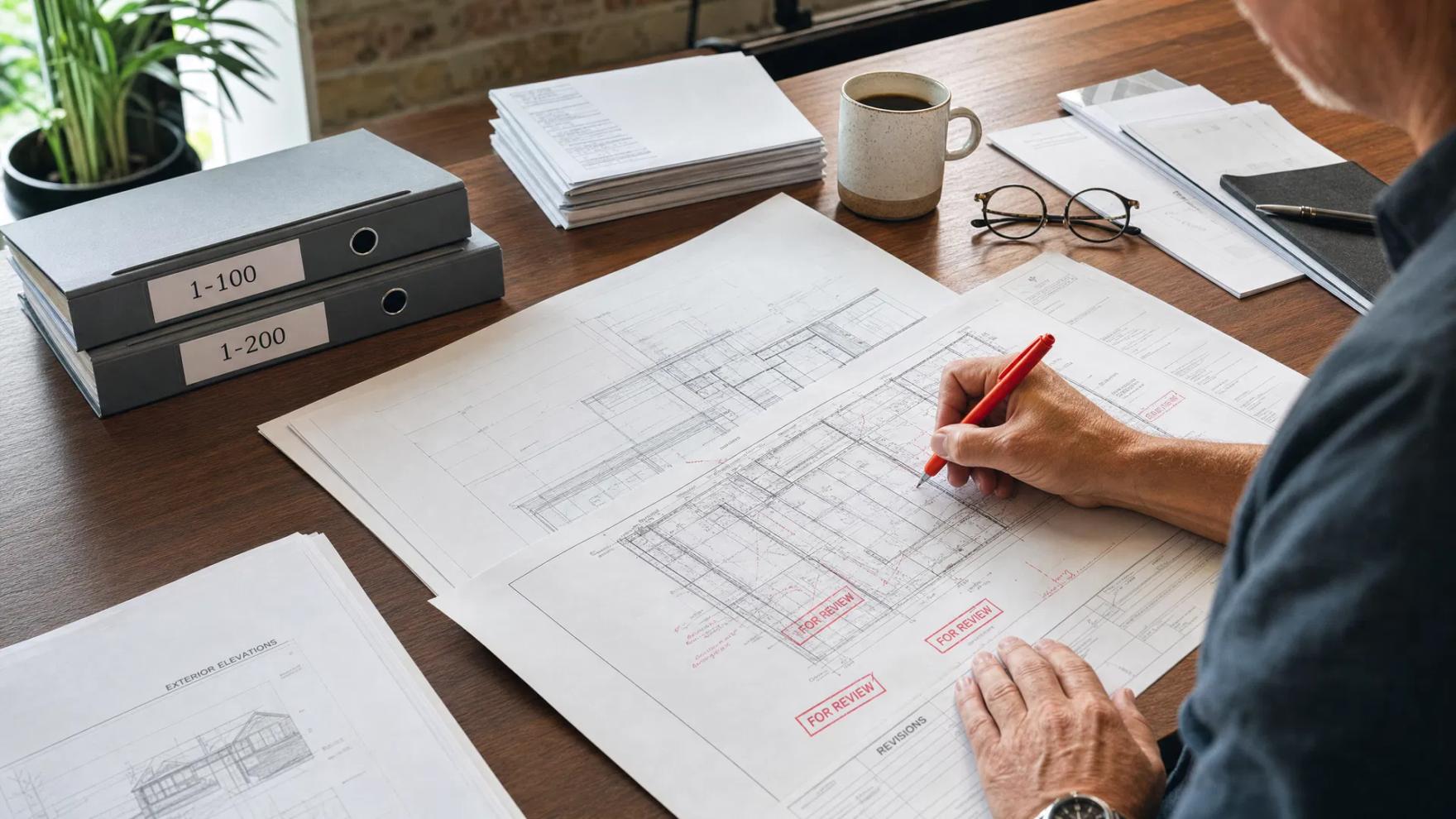
A rejected submittal is rarely about bad woodwork. It is about a drawing that left a reviewer with a question. These are the five questions that get packages kicked back most often — and how to answer them before you submit.
- Cost of a rejection
- Often two weeks of timeline plus a full revision cycle
- Most common cause
- Uncoordinated dimensions and missing schedules, not design errors
- The fix
- A pre-submittal review against the contract documents and a senior set of eyes
1 · Dimensions that don’t coordinate
The plan says one thing, the elevation says another, and the section disagrees with both. A reviewer who finds one mismatched dimension stops trusting every dimension, and the package comes back. The fix is to detail against the architectural backgrounds so plan, elevation, and section are generated from one coordinated source — not drawn independently and reconciled by hope.
2 · Missing or incomplete hardware schedules
Hinges, slides, and pulls quantified “by others” or left off entirely force the reviewer to assume — and assumptions get redlined. Every package should carry a hardware schedule with part numbers, quantified by unit, so procurement and review both have a single source of truth.
3 · Joinery left to the imagination
An elevation shows what a piece looks like; it does not show how it goes together. Rated, structural, or complex assemblies need the connection drawn. When the section stops at the face and the joinery is implied, a careful reviewer rejects it — and a careful fabricator would have called you anyway.
4 · Finish specs that don’t match
The architect specified a laminate, a stain, or a veneer match in the project manual. If your drawing calls out something close-but-different, that is a rejection on a single line of text. Pull finish callouts directly from the spec and reference them by sheet.
5 · No clear scope boundary
Commercial packages live next to other trades. When the drawing doesn’t flag what is by others — tile substrate, electrical, support steel — scope gets double-bid or dropped, and the reviewer cannot tell where your work ends. Note it explicitly, the way a clean set marks “tile by others on cement board.”
None of these are woodworking problems. They are drawing-discipline problems, and every one is caught by a pre-submittal checklist and a senior review before the package goes out.